
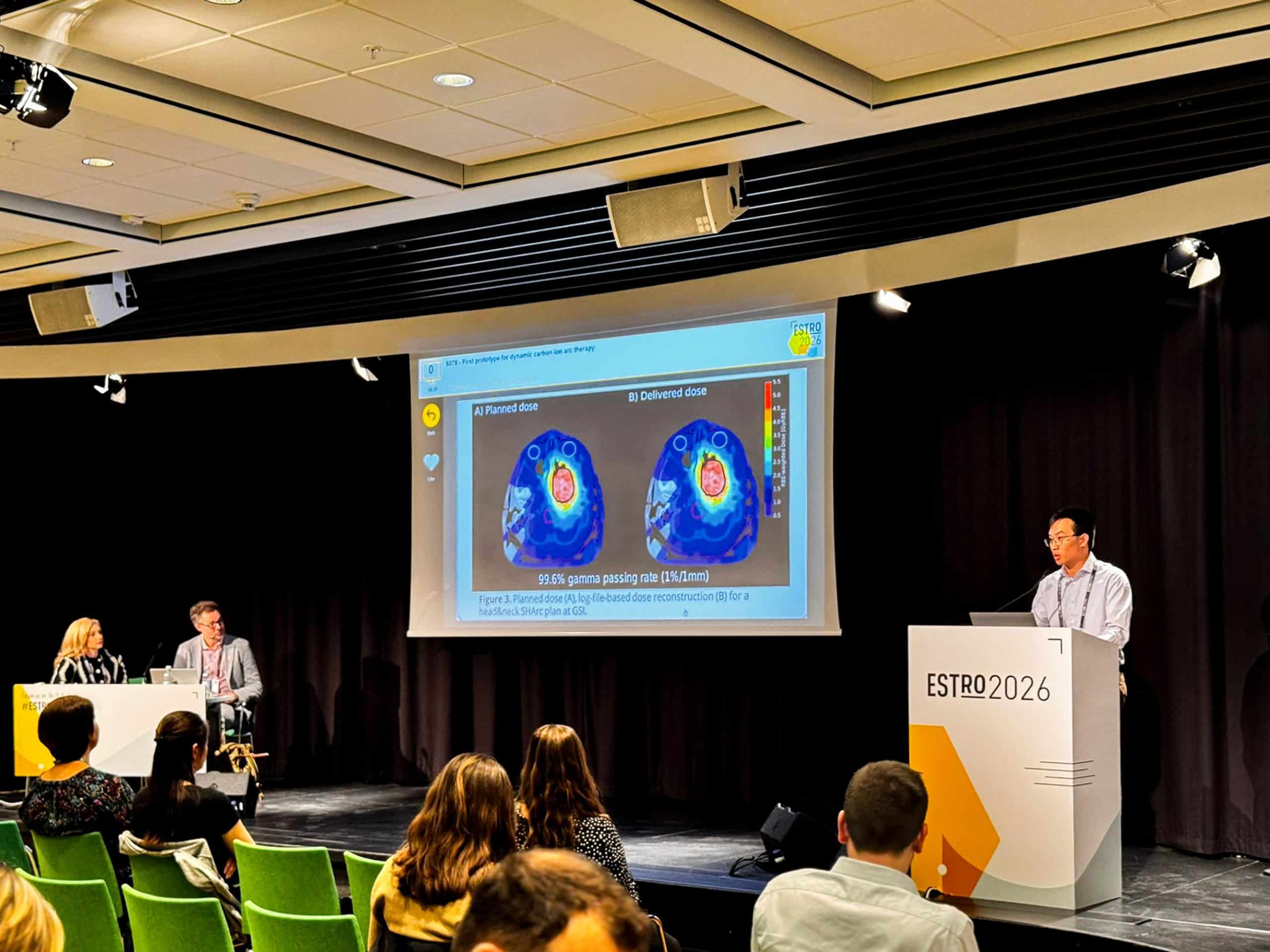
The past few months have marked an extraordinary milestone for the UPLIFT consortium. In May and June 2026, our network of Doctoral Candidates (DCs) and supervisors traveled to present their pioneering research at two of the world’s premier radiation oncology and particle therapy conferences: ESTRO 2026 and PTCOG64. These flagship events provided the perfect global platform to demonstrate how UPLIFT is actively driving the future of upright radiotherapy.
Driving the Upright Momentum at ESTRO 2026
Our journey began at ESTRO 2026, where UPLIFT’s research focus took center stage. A major highlight of the conference was an inspiring debate co-chaired by supervisor Ye Zhang (PSI), featuring supervisor Petra Trnkova (CTU) on the motion: “Upright position will be a mainstream and standard radiotherapy delivery option by 2035.” The presentation successfully converted over one-fifth of the crowd, resulting in a resounding two-thirds majority supporting the motion and validating the massive global momentum behind our project’s vision. Alongside this milestone discussion, DCs Lola Vegeas (hosted by TheraPanacea), Zixin He (hosted by GSI), and Chrysoula Rousi (hosted by České Vysoké Učení Technické v Praze / CTU) successfully shared their research with the global community, with their featured presentation abstracts published in the official ESTRO abstract book.
Clear Clinical and Technical Breakthroughs at PTCOG64
The momentum carried over into PTCOG64, where our DCs showcased crucial advancements in upright particle therapy through a series of highly successful oral presentations.
Focusing on treatment optimization, María Plana (hosted by CNAO) demonstrated how integrating shoot-through beams into upright particle therapy can significantly enhance plan robustness against anatomical changes while enabling in-vivo range verification. Providing essential clinical evidence, Guangsheng Li (hosted by GSI) shared key insights from a retrospective analysis of lung cancer patients treated in an upright position at Hadassah Medical Center, proving that the approach offers reliable patient positioning reproducibility and stable tumor motion. Finally, wrapping up our oral sessions, Wouter van Weerelt (hosted by RaySearch Laboratories) illustrated how utilizing bidirectional chair rotation can optimize beam delivery paths and shorten carbon ion treatment times by up to 25%.
Empowering the Next Generation of Researchers
For our early-stage PhD students, participating in these premier flagship conferences has been an invaluable and empowering experience. Beyond successfully presenting their own results, the DCs had the unique opportunity to engage with global experts, exchange pioneering ideas, and witness firsthand the rapidly growing clinical appetite for upright treatment solutions.
This immense progress and successful dissemination would not have been possible without the dedication of our consortium partners and the continuous funding support of the European Union. As our team returns to their respective labs, they bring back fresh clinical insights and a shared drive to push the boundaries of particle therapy even further.
This work was co-funded by the European Union under Grant Agreement No. 101168955.