1. GSI Helmholtzzentrum für Schwerionenforschung (Germany)
2. Centre de Lutte Contre Le Cancer Leon Berard (France)
3. Centro Nazionale di Adroterapia Oncologica (Italy)
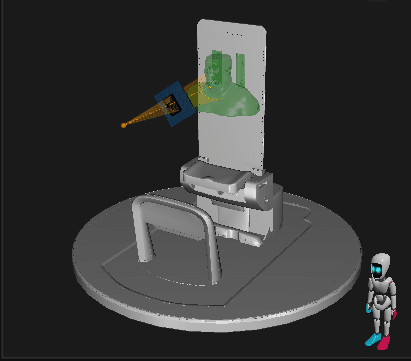
RaySearch Laboratories have been conducting research and development within advanced radiotherapy treatment planning for over 20 years. Our treatment planning system RayStation has support for a wide array of modalities, including photons, electrons, boron-neutron capture therapy (BNCT), protons and light ions. A transition to upright treatments could provide both clinical and cost efficiency gains for all modalities, with particular advantages for treatments where upright treatments omit the need for large and expensive gantries (e.g. protons and light ions).
The transition to upright treatments must be preceded by updates to important parts of the treatment planning process, and research is needed both to address new challenges and to develop new techniques. This PhD project will mainly focus on proton, light ion and photon treatments.
For protons and light ions, a main topic is upright arc therapy, where the beam is delivered from a multitude of directions, preferably while the patient is rotated. Advancements on the accelerator side, such as multi-leaf collimated arcs and machines with fast energy switching can push this development forward, and versatile optimization algorithms for such accelerators have the potential to set a new state-of-the-art in ion treatments.
For photons, the machines have the potential to become even more compact and allow for faster collimation, and the possibility to translate the patient vertically while rotating opens for helical arcs.
New uncertainties arising in upright positions, including challenges regarding patient positioning and organ motion, should be accounted for in the treatment planning process. Extension and use of the integrated algorithms for robust optimization in RayStation will be part of this research.
The goal of the PhD project is to develop prototype versions of RayStation, which will be used to perform research studies within the realm of upright radiotherapy. The prototype development will include implementation of new mathematical optimization algorithms in combination with dose computation for photon, proton and ion therapy. The project will involve mathematical optimization, and computer science, as well as radiotherapy physics. Software development in languages such as C++, C# and Python will be an integral part of the project.
Within the doctoral network there will be continuous collaboration with other doctoral candidates, especially from GSI (Germany), CNAO (Italy) and Centre Léon Bérard (France), where the doctoral candidate will have longer or shorter secondments. A natural point of collaboration will include evaluation of the newly developed methods by retrospective planning on clinical patient cases.
Wouter van Weerelt
RaySearch Laboratories
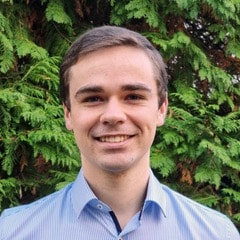
My name is Wouter van Weerelt and I’m from the Netherlands. Before starting my PhD project, I was studying a dual master’s degree program at KTH and TU Berlin called Computer Simulations for Science and Engineering, which falls under Applied and Computational Mathematics. Prior to that, I competed my bachelor’s degree in Applied Physics at TU Eindhoven.
My PhD project is titled “Advanced Upright Treatment Planning” and takes place at RaySearch Laboratories and KTH Royal Institute of Technology. The project is under the supervision of Erik Engwall, Lars Glimelius and Rasmus Bokrantz at RaySearch, and Jan Kronqvist and Anders Forsgren at KTH.
The main focus of the project will be the development, extension, and implementation of improved optimization algorithms suited to the challenges and opportunities presented by upright radiotherapy.
This process will likely involve closely examining (among other things) the energy layer selection problem as well as investigating methods of inverse spot selection. In the context of upright radiotherapy, I will also consider a number of different modalities, including protons, carbon and photons. By the end of the project, I hope to have made some contribution to upright treatment planning through novel optimization approaches.
I’m very happy that this project allows me to combine my interest in mathematical optimization with an application area as important as radiotherapy. I also think this doctoral program is also an excellent opportunity to collaborate with other institutions and doctoral candidates, in order to advance the field of upright radiotherapy. Finally, I hope being an industrial PhD at RaySearch gives me the extra perspective of also working in industry, which might allow me to have the best of both worlds combined with my supervision at KTH!
RaySearch develops innovative software solutions to improve cancer care. About 1000 clinics in more than 40 countries use RaySearch software to improve treatments and quality of life for patients. The headquarters is located in Stockholm, with subsidiaries in the US, Europe, Asia and Australia & New Zealand. Today we have more than 410 employees with a common vision of improving cancer care with innovative software. We engage in numerous research projects together with clinical partners to develop new ideas and concepts together with other researchers and end users.