1. ASG Superconductors S.p.A. (Italy)
2. Paul Scherrer Institute (Switzerland) Leo Cancer Care (UK)
3. Leo Cancer Care (UK)
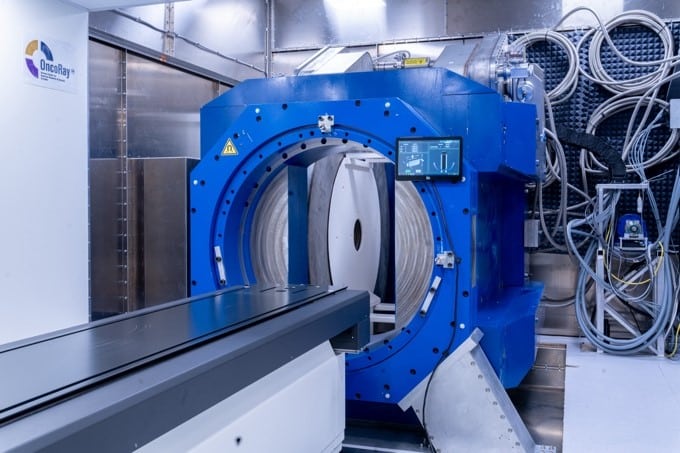
Magnetic resonance imaging (MRI) has the capability to provide unrivalled soft-tissue contrast images in real-time. However, the development of in-beam MRI for proton therapy has only recently started and not yet reached technical maturity to be introduced into the clinic. Recently, a unique, whole-body in-beam MRI device has been installed at HZDR/OncoRay in Dresden (Germany). By means of the rotating, open-bore magnet, this device offers the possibility to scan and irradiate patients in both recumbent and upright posture.

Objective
The aim of this project is to optimize this in-beam MR scanner for image acquisition and treatment planning studies in upright position, identify potential technical hurdles to be overcome for upright rotational proton therapy, and develop a conceptual design for a future clinical upright MR-integrated proton therapy system.
Tasks
To understand the technical requirements to enhance the available in-beam MRI system for clinical use. To optimize the image quality for upright patient scanning and to acquire MRI data of patients for treatment planning studies on upright proton therapy using real-time MRI guidance. To perform computer simulation studies to conceptually design an in-beam upright MRI system for rotational proton therapy.

I’m Courtney Ford and I hail from the US. My background is in aerospace engineering and physics, and I have experience working in research and development for aviation applications. I received my Bachelor’s degree in aerospace engineering from Wichita State University, located in the air capital of the world, Wichita, KS. My Master’s degree in physics came from the Rheinische Friedrich-Wilhelms-Universität Bonn and I completed my Master’s thesis at the Forschungszentrum Jülich helping to design an actuator for use in wind tunnel-based drag research.
Prior to joining UPLIFT, I worked on aircraft engine research for several years. I’m hosted by the OncoRay, HZDR, and Technische Universität in Dresden under the supervision of Prof. Dr. Aswin Hoffmann. My project is to design an isocentric MRI-guided upright particle therapy MR scanner. This scanner needs to have certain characteristics, including compatibility with proton therapy, a uniform magnetic flux field in the magnet isocenter, and above all a large enough gap between the magnet heads for the comfortable rotation of an adult patient.
I chose this topic because I wanted the opportunity to design an MR scanner with the freedom to simulate any configuration I can imagine and to consider every potential solution. I intend to find the best possible design implementation for the next generation upright MR scanner at the OncoRay.
In my free time, I enjoy hiking, sports like tennis and lacrosse, Iaido (a Japanese sword-based martial art), reading, and playing the piano. Since moving to Dresden, I’ve also taken up winter swimming, and have joined a group of people who jump into lakes in freezing temperatures (after cutting through the ice with axes).