- Home
- Projects
- Project 1: Upright time-resolved MRI
- Project 2: Machine learning based deformable registration
- Project 3: Advanced upright treatment planning
- Project 4: Motion mitigation in upright position
- Project 5: Upright particle arc therapy
- Project 6: Clinical upright radiotherapy workflow at a photon centre
- Project 7: Clinical upright radiotherapy workflow at a particle centre
- Project 8: Quality assurance software for upright radiotherapy
- Project 9: Quality assurance workflow and dosimetry
- Project 10: Upright immobilization and positioning
- Project 11: Design of isocentric MRI guided upright particle therapy
- Project 12: Upright PET imaging
- Project 13: Antropomorphic phantoms for upright treatment validation
- Project 14: Patient empowerment: The human aspect of particle therapy
- Project 15: Socio-economic impact analysis of upright radiotherapy
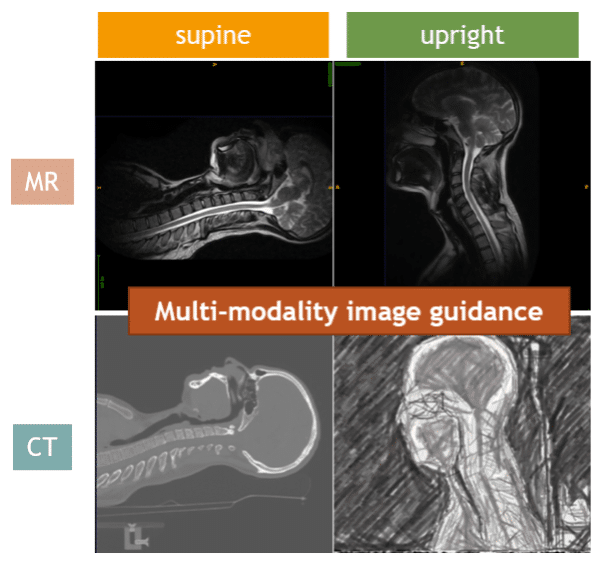
- Project 16: Multimodal imaging for upright posture
- Project 17: Anatomical differences analysis between upright and supine position
- Project 18: Human factors and ergonomics to evaluate and improve patient positioning for upright radiotherapy
- Project 19: Patient empowerment: The human aspect of radiotherapy
- Recruitment
- Members
- Knowledge base
- Contact