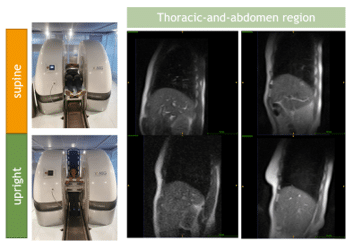
Project 17: Anatomical differences analysis between upright and supine position

Enrollment: ETH Zurich

Host institution: Paul Scherrer Institute
Planned secondments
  1. ASG Superconductors (Italy)
  2. Loughborough University, Leo Cancer Care (UK)
  3. Deutsches Krebsforschungszentrum Heidelberg (Germany)
Supervisor
Co-Supervisor
Tony Lomax
Share This

Project description

Background and Motivation: 

The anatomical differences between upright and conventional supine or prone positioning in radiotherapy are significant, which presents new challenges in upright treatment planning. Comprehensively understanding anatomic differences and associated dosimetric impacts is essential to define clinical indication and treatment workflow for Upright RT. 

Goal: 

A comprehensive set of image datasets for the listed anatomical sites for upright treatment simulations encompassing both imaging and treatment planning and comparative upright vs. supine studies. 

Tasks:

  • Conduct the comparative image acquisitions for HN, thoracic, upper and lower abdomen (in collaboration with ASG) 
  • Evaluate anatomical differences and organ motion between upright and supine positioning
  • Define treatment planning criteria and margin recipe via comprehensive comparison planning studies (in collaboration with Raysearch and GSI) 


  • 3 months secondment @ASG (Upright MR imaging)
  • 3 weeks research visiting @LU/LCC (supporting device)
  • 3 weeks research visiting @GSI (arc-PT planning) 


  • Close collaboration with ESR1 and PhDs students in PSI-CPT
  • Teaching assistant for ETHz Physics department
  • Presentation of research in the form of peer-reviewed publications, reports and oral presentations in workshops, symposiums and conferences
  • Participation in Consortium training activities and secondment projects

Daniel Richter

Paul Scherrer Institute

Project DC17, “Anatomical Differences Analysis,” is carried out by Daniel Richter at the Paul Scherrer Institute (PSI) in Switzerland. He began his PhD in September 2025 under the supervision of Dr. Ye Zhang, a tenured scientist at the Centre for Proton Therapy (CPT) at PSI.

He obtained his Bachelor’s and Master’s degrees in Physics from the University of Heidelberg, Germany, focusing on fundamental and computational physics. He completed his master’s thesis at the German Cancer Research Center (DKFZ), where he concentrated on optical imaging techniques in fluorescent cancer research. Inspired to transition from preclinical projects to impactful clinical medical research, he was drawn to the challenges and opportunities of advancing adaptive radio- and proton therapy through a combination of computational and experimental approaches.

His project investigates the significant anatomical changes that occur when a patient moves from a traditional supine (lying down) to an upright position. Understanding how gravity affects organ position and tissue shape is vital for ensuring that proton beams accurately target tumors while sparing healthy tissue. The project aims to develop and apply robust methods to quantify these anatomical differences and translate the findings into data-driven solutions for personalized radiotherapy. As part of this work, he leverages his background in fundamental physics and AI-driven medical imaging to tackle complex translational research problems with real-world clinical relevance.

Excited to join UPLIFT’s interdisciplinary environment, he aims to advance state-of-the-art research, develop his professional skills, and build a strong international network—key elements for addressing today’s complex research challenges. In his spare time, he enjoys rock climbing and skiing, activities that allow him to stay active and embrace new challenges.

Additional:

Daniel Richter | LinkedIn

Paul Scherrer Institute

The Paul Scherrer Institute (PSI) is the largest research institute in Switzerland, and the Center for Proton Therapy (CPT) is the only radiotherapy department in the country offering this unique, highly precise proton radiotherapy treatment. The PSI-CPT has been a long-lasting global leader and pioneer in developing and clinically implementing pencil beam scanning and Intensity Modulated Proton Therapy. As a fully operational proton therapy center, PSI-CPT boasts a comprehensive suite of related equipment, including a proprietary pencil beam scanning proton therapy system with three gantries ...