Project 11: Design of isocentric MRI guided upright particle therapy

Enrollment: Technische Universität Dresden

Host institution: Helmholtz-Zentrum Dresden-Rossendorf
Planned secondments

1. ASG Superconductors S.p.A. (Italy)
2. Loughborough University, Leo Cancer Care (UK)
3. Paul Scherrer Institute (Switzerland)

Supervisor
Co-Supervisor
Bradley Oborn
Share This

Project description

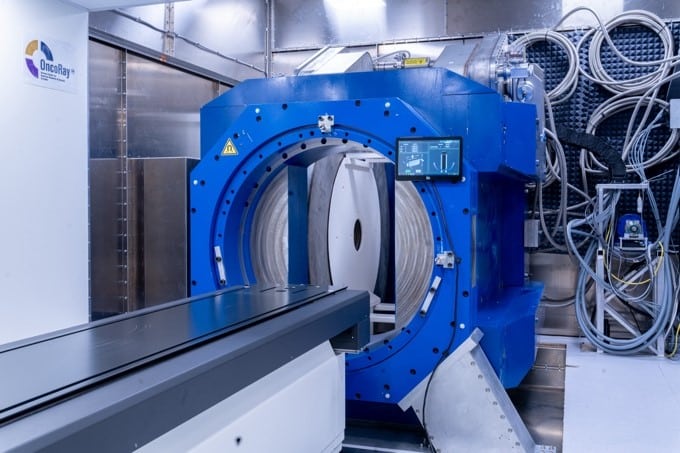
Magnetic resonance imaging (MRI) has the capability to provide unrivalled soft-tissue contrast images in real-time. However, the development of in-beam MRI for proton therapy has only recently started and not yet reached technical maturity to be introduced into the clinic. Recently, a unique, whole-body in-beam MRI device has been installed at HZDR/OncoRay in Dresden (Germany). By means of the rotating, open-bore magnet, this device offers the possibility to scan and irradiate patients in both recumbent and upright posture. 


Objective 

The aim of this project is to optimize this in-beam MR scanner for image acquisition and treatment planning studies in upright position, identify potential technical hurdles to be overcome for upright rotational proton therapy, and develop a conceptual design for a future clinical upright MR-integrated proton therapy system. 


Tasks 

To understand the technical requirements to enhance the available in-beam MRI system for clinical use. To optimize the image quality for upright patient scanning and to acquire MRI data of patients for treatment planning studies on upright proton therapy using real-time MRI guidance. To perform computer simulation studies to conceptually design an in-beam upright MRI system for rotational proton therapy. 

CourtnezFord

Courtney Ford

Helmholtz-Zentrum Dresden-Rossendorf

Courtney Ford is working on Project 11: Design of isocentric MRI guided upright particle therapy. She is hosted by OncoRay and the HZDR in Dresden under the supervision of Aswin Hoffmann. Originally from the US, her background is in engineering and physics, and she has experience working in aerospace research and development.

Courtney chose this topic because she wanted the opportunity to design an MR scanner with the freedom to simulate any configuration she can imagine and try every potential solution. She hopes to find the best possible design implementation for the next generation upright MR scanner at the OncoRay.

In her free time, Courtney enjoys hiking, playing tennis, and Iaido.

Additional:

Courtney Ford | LinkedIn

Helmholtz-Zentrum Dresden-Rossendorf

Through cutting-edge research, the Helmholtz-Zentrum Dresden-Rossendorf (HZDR) solves pressing societal and industrial challenges of our time. A strong collaboration between the HZDR, the Faculty of Medicine Carl Gustav Carus and the University Hospital Carl Gustav Carus jointly operates OncoRay center. Cancer patients are treated with proton therapy at the University Proton Therapy Dresden. In the facility’s experiment room, the world’s first in-beam MRI system for proton therapy was developed in 2017. Since then, HZDR / OncoRay is pioneering MRI-integrated proton therapy