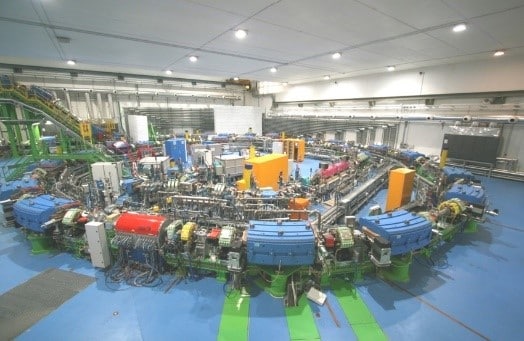
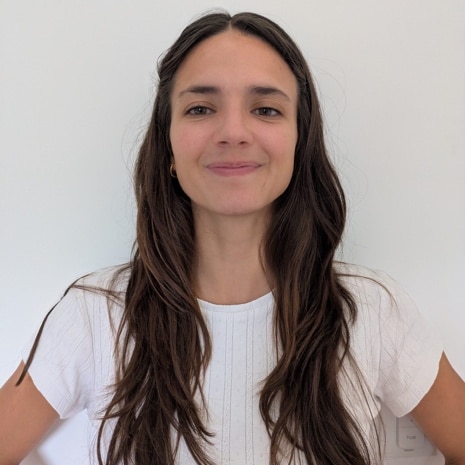
Hola! I’m María, and I was born in a town near Madrid, Spain. My background is in Physics, with a bachelor’s degree from Rijksuniversiteit Groningen and a master’s degree from Universität Heidelberg. During my studies, I focused on particle, computational, and medical physics, doing research with the LHCb group, at DKFZ, and HIT. Now, I am based in Italy at CNAO, enrolled as a PhD student from the Università di Pavia, working under the supervision of Mario Ciocca and Ester Orlandi.
My role in the UPLIFT project is to define a clinical workflow for upright radiation therapy in a particle facility. Central to this project is the installation and commissioning of the Leo Cancer Care upright system, Marie, expected to take place in 2026. My duties range from treatment planning, to determine the most suitable clinical indications for particle therapy at CNAO, to studying range accuracy and immobilization techniques. Finally, I’ll be developing and validating an end-to-end workflow in collaboration with physicists, engineers, radiation oncologists, and patients. I hope my work supports the clinical integration of upright therapy and the broader adoption of compact facilities.
I chose this topic because I wanted to apply my physics knowledge in a real clinic. After spending time with simulations and work “behind the screen,” I find it rewarding to be in the hospital and see how science becomes something tangible that helps real people. It’s important to me that this technology doesn’t just stay in a lab. My goal is to help these tools become a standard part of care, and hopefully, to see them implemented in Spain one day so that patients there have access to the best treatment options.
Outside of work, I enjoy climbing, skiing, or surfing, and I’ve recently gotten my diving certificates too. I also try to catch up with my family and friends as often as I can, or work through a long travel bucket list whenever I get the chance.
María Plana | LinkedIn